

Publishers have been urged to experiment with AI controls in the aftermath of the UK competition watchdog’s new rules for Google.
Senior publishing leaders were told it would be a “travesty” if none of them made the most of the ability to opt out of their content appearing in AI Overviews and AI Mode, as prompted by the Competition and Markets Authority’s publisher conduct requirements for Google search.
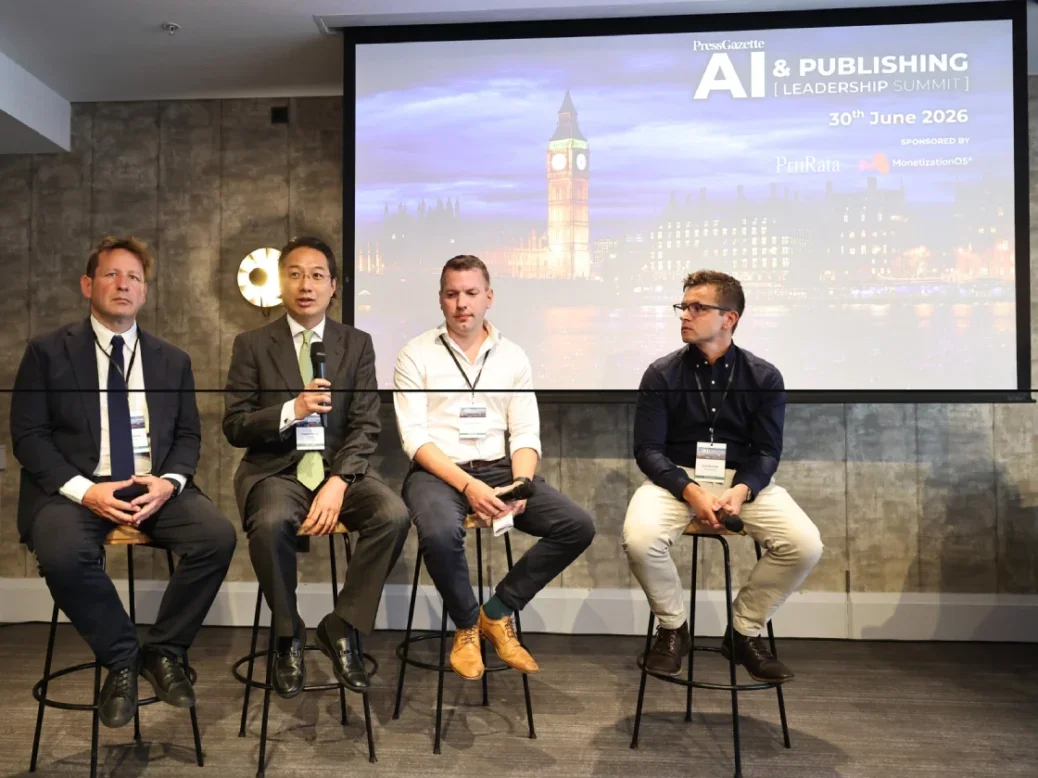
Former Conservative culture minister Lord Ed Vaizey, Prorata senior strategy adviser Eugene Huang, The Economist’s VP of generative AI Josh Muncke and Owen Meredith, managing director of public policy at Daily Mail, spoke about what publishers should do next on a panel at Press Gazette’s AI Summit in London last week.
The CMA told Google to give publishers control over how their content is surfaced in AI answers, something the search giant is now testing.
However, Google has reportedly threatened to exclude them from its pilot AI deals if they opt out of AI Overviews.
Huang, who co-founded Prorata which sponsored the panel, described the CMA ruling as “pretty historic”.
He acknowledged that the CMA did not provide “everything that the publishing industry wanted”, pointing to the fact publishers would still have to opt out rather than opt into their content being used, and that it will “take a while” for Google to implement changes.
But he believes “it is incumbent upon the publishing industry to begin to experiment when some of these changes come in… sure, you might not like that it is opt out versus opt in, but it will be a travesty if none of you decide that opting out is an action that you want to take.”
Huang, who worked at Google from 2022-23, continued: “The reason why I say that is, first and foremost, the CMA is going to be watching and taking a look and seeing what happens in terms of the industry’s reaction, as well as Google’s reaction to this sort of stuff, but also… we’re in the very, very early stages of AI, and if you’re not going to take action now to begin to experiment, it might be too late 18 months from now, 36 months from now, when we all worry about Google Zero, when traffic potentially is falling off the floor, and all of a sudden you’re like, oh my gosh, I can’t touch this now, because it’s too late.
“And so, what I will say is that it’s not just experimenting with the tools, it’s… engaging overall in the process. I do believe, and part of the reason why Prorata was founded, is that this is an existential threat to the industry, although it can be also a great tool for the industry.”
CMA ruling is ‘pathway to test and experiment’
Daily Mail’s Owen Meredith, who until May led the News Media Association as chief executive, similarly said he thought “publishers should be looking to exercise” their right to opt out.
He also referred to the fair ranking conduct requirement (CR) being imposed by the CMA on Google, which means the search giant must rank results “based on objective and non-discriminatory criteria, including in search generative AI features” and provide transparent information about how the search algorithm works.
“We need to look at how the opt out interacts with the fair ranking conduct requirement, because that is what designed to give publishers the negotiation power and the bargaining power,” Meredith said.
“Part of the ranking requirement is that where your publisher content is most relevant to the search query, your content should rank above an AIO, and that’s critical to how the CRs operate.”
Josh Muncke of The Economist said of the CMA ruling: “I view this as another pathway for us to test and experiment and learn what works and what doesn’t work in an ecosystem that is moving really quickly, and so I think what we’re trying to do at this point is to stay agile and put technical resource behind this to test what works for us and our audiences specifically.”
Muncke predicted that as publishers respond to the AI market, they will need to choose one of two tactics.
“There’s going to be a barbell effect in the publishing industry as at some point publishers are going to be forced into one of two camps,” he said.
“The CMA ruling means publishers have to think about how they want to play: are we creating our owned surfaces so we’re a destination, we’re locking things down, we’re trying to drive people directly towards our platforms, making them more useful, more conversational?
“Or are we trying to play a game where we’re optimising for discovery and agentic surfaces, we’re opening things up, we’re creating machine-readable formats? I think there will come a time where it will be hard to straddle both of those worlds. It plays into a lot of the tensions between what you do with your content and what you do with your internal resources.”
Attribution ‘one part of the puzzle’ for AI publisher payments
The panel discussed how publishers can get paid for their content as AI models increasingly scrape their websites and use their content for training and grounding. If they don’t have a licensing deal with the LLM then this is done without permission or payment under what companies like OpenAI claim is fair use.
Lord Ed Vaizey drew “parallels” between the current AI copyright battle and the music industry’s copyright infringement by Napster at the start of the 2000s.
“The principle remains the same as it was 20 years ago,” he said. “People create content, and if you use that content, you should attribute that content, and you should pay for that content, and that applies to an individual, but it also applies to the big AI companies, and we need to find a way where there is a win-win.”
Prorata, in which Daily Mail was an early investor, promises to share revenue with publishers by the proportion of their content used to create each AI-generated answer.
Huang said this output-based approach is “about value exchange… ultimately we are agnostic in terms of how publishers get paid. We encourage publishers to get paid in whatever way, shape, or form they can get paid, but the difference between input and output is very simple, very clear.
“If you’re one out of a billion words, that is not necessarily a fair value exchange, but ultimately, if you take a look at the output coming from a large language model, a chatbot, anything that uses AI, and if you’re responsible for 30, 40, 50% of that content, what we argue is that ultimately you should get paid based upon the proportion of value that you create that is attributable to you.”
Huang said other AI companies are “gaslighting” when they say this is not possible because admitting it is would “undercut” a lot of their legal arguments.
“They have three major inputs. Two of them they’re paying for: labour and compute. The third one, which is your content, they’re not paying, and that underpins their legal arguments, legal arguments like it’s fair use, legal arguments that, oh, you know, it’s impossible to attribute, it goes through the blender.”
Daily Mail’s Meredith said however that an attribution model is not “one-size-fits-all” for publisher payments.
“Attribution is one part of the puzzle, it’s not the whole solution. Data and insight transparency is clearly necessary.
“I mean, attribution is essentially forcing companies to say this is where I stole your content from. If I’m selling you something on a market, and say, by the way, I stole this from your garage last week, that’s handling stolen goods. That in itself is a criminal offence. That’s the kind of equivalent that we’re looking at here if attribution isn’t done with full transparency and full data transfer.
“And it’s also not going to be a one-size-fits-all model. Increasingly we’re seeing, and I suspect you’ll see this accelerate, the use of voice prompts and voice and audio responses. The value that can be achieved by a publisher from attribution within a voice response versus a hyperlinked attribution within a text output is very different. So attribution is not going to deliver one-size-fits-all. It’s going to have to be flexible across the market.”
Economist joins AI licensing standards collective SPUR
Muncke echoed the need for data: “Ultimately the big challenge, in my view, will not be the technical challenge of defining the metrics or going to the attribution model, it will be getting inside the box of these companies to actually implement the systems or the telemetry or the attribution models that emit that data back out. And I think that almost ends up being a geopolitical challenge rather than a technical one.”
Muncke announced at the event that The Economist is joining the SPUR coalition of more than 30 global news publishers aiming to decide an industry standard for how AI platforms report on use of the content they scrape.
SPUR published its proposed “signal format for content usage reporting” last month.
Huang said taking part in both industry initiatives like SPUR and negotiations for bilateral deals is “probably a smart move” amid concerns raised at the event that publishers breaking ranks for short-term cash and out of FOMO (fear of missing out) could impact the efficacy of collective action.
He noted reports that OpenAI “want to pick off the top two in every single market, and then leave the rest of the industry behind”, adding that “it is a no-brainer to engage in certain industry collectives like the SPUR coalition. Every business is going to have to evaluate what is the best course of action.”
Email pged@pressgazette.co.uk to point out mistakes, provide story tips or send in a letter for publication on our "Letters Page" blog
